
Stop saying “um”
Filler words usually fill a gap while you think. You do not need to remove every one: notice where they cluster, then practise replacing them with a short pause.
Try a practice answerWhy we say “um”
Words such as “um”, “uh” and “er” are a normal part of speech. They signal that you are still thinking and have not finished. In conversation, listeners barely notice an occasional one.
In an interview, they become distracting when they are frequent, when they open nearly every sentence, or when they combine with phrases such as “you know” and “basically” to make an answer sound unsure. The aim is fewer distracting fillers, not none.
Find your pattern first
Record a two-minute answer and listen back. Most people have one or two habitual fillers that turn up in predictable places:
- At the start of an answer, while you decide what to say.
- Between points, as you move from one idea to the next.
- Before a specific detail, such as a number or a name you are trying to remember.
- At the end, when you are not sure how to finish.
Techniques that help
- Pause instead.
When you feel a filler coming, close your mouth and pause. A second of silence sounds far more deliberate to a listener than it feels to you.
- Know your first sentence.
Many fillers happen while you look for a way in. Prepare openings for common questions, such as “There are two reasons…” or “A good example is from my placement…”.
- Plan your transitions.
Signposts such as “The second thing was…” or “As a result…” give you something to reach for instead of a filler.
- Know how you will finish.
Decide on a closing sentence that ties back to the question, so you can stop cleanly instead of trailing off with “so, yeah”.
- Slow down a little.
Fillers often increase when you speak faster than you can plan. A slightly slower pace gives your thoughts time to catch up.
A five-minute drill
- Record a first take.
Answer a familiar question for about a minute without preparing.
- Count and locate.
Note how many fillers you used and where they came. Look for the cluster rather than the total.
- Target one spot.
If most came at the start, prepare your first sentence. If they came between points, plan your transitions.
- Record again.
Answer the same question, focusing only on that spot. Compare where your fillers fall in the two takes.
How DontBlank counts them
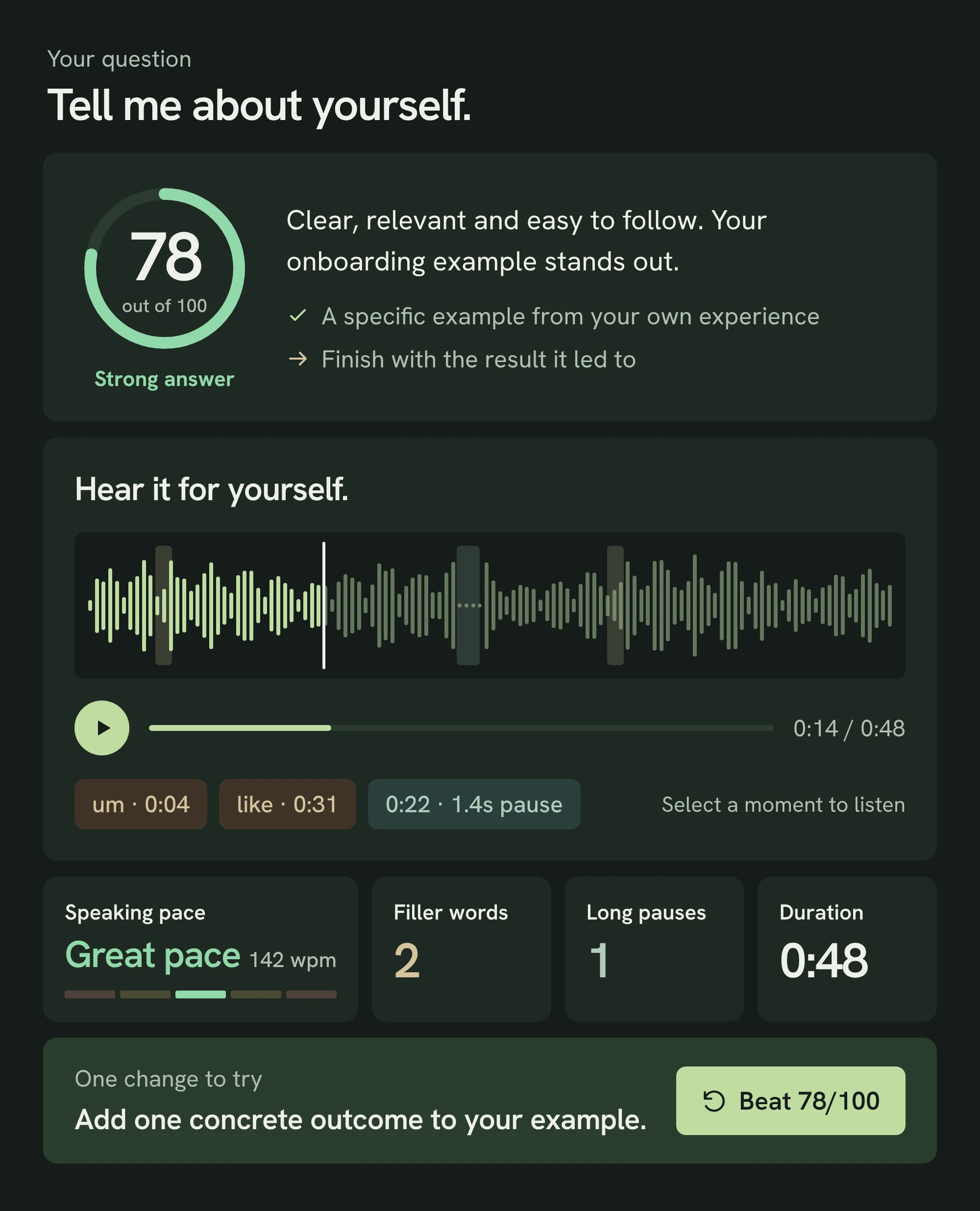
DontBlank counts “um”, “uh”, “er”, “erm”, “ah” and “hmm”, along with “like”, “basically”, “actually”, “you know” and “I mean”. Each one is marked on your recording’s waveform, so you can jump straight to it and hear the context.
Words such as “like” and “actually” are often meaningful (“I’d like to…”), so treat the count as a prompt to listen, not a verdict. The report also separates well-placed pauses between ideas from hesitant ones in the middle of a phrase or next to a filler.
Common questions
How many filler words is too many?
There is no fixed number. Listen for whether they distract from your point or make you sound unsure. A few spread through a two-minute answer are rarely a problem; one before nearly every sentence usually is.
Is it better to pause or say “um”?
A short pause usually sounds more composed. Pauses at the end of sentences and between ideas sound natural to most listeners, even when they feel long to you.
Will I ever stop completely?
Probably not, and you do not need to. Most fluent speakers use some fillers. The goal is to stop them getting in the way of your answer.
Now say it out loud.
Use your own example. Record a first take, listen back and choose one thing to make clearer.